Decanting: when it matters (and when it doesn't)
by Patrick Mur • 7 min read
Decanting has an air of ceremony about it — the special vessel, the careful pour, the sense that something important is happening. Strip that away and it's simply a tool that does two jobs. Knowing which of them, if either, your bottle actually needs is the whole skill. Everything else is theatre.
It only really does two things
A decanter isn't magic. It gives a wine air, and it separates a wine from its sediment. That's the list. Most of the mystique is people doing one of those two things — or, just as often, doing neither and enjoying the ritual anyway. Once you know which job is in front of you, the decision gets simple.
In practice: In practice — Before you reach for the decanter, ask one thing: does this wine need air, or does it need cleaning up? If neither, leave it in the bottle.
Job one: giving a young wine air
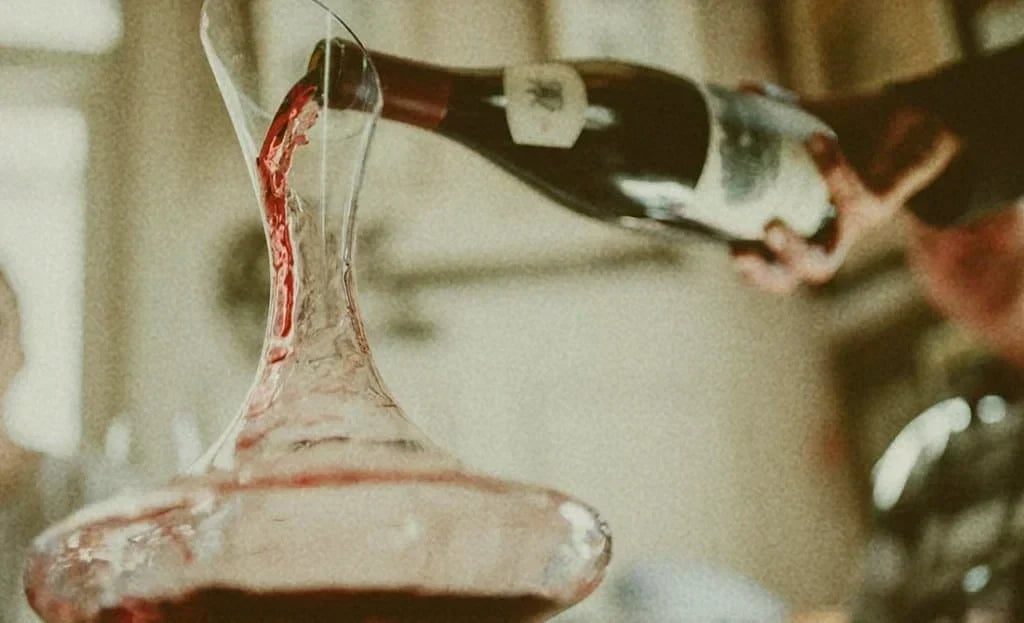
A young, tannic red poured straight from the bottle can taste tight and gripping. Pouring it into a decanter spreads it across a wide surface and opens it quickly — the same thing swirling in the glass does, just faster and for the whole bottle at once. Big, structured young reds — Barolo, young Bordeaux, Syrah — gain the most.
In practice: For a young, tannic red, decant 30 minutes to a couple of hours before serving — and pour it in with a bit of splash. The more air, the faster it opens.
Job two: leaving the sediment behind
Older reds throw a fine sediment as they age. It's harmless, but gritty in the glass. Decanting lets you pour the clear wine off and leave the sediment in the bottle — the original, and gentlest, reason the decanter exists.
In practice: In practice — Stand an old bottle upright for a day first so the sediment settles, then pour slowly in one steady motion and stop the moment sediment reaches the neck. A light or candle behind the shoulder helps you see it coming.
When decanting does nothing — or harm
Most everyday wines need neither job: they're ready to drink and have no sediment, so a decanter adds nothing but washing-up. And with fragile older wines, air is a risk — they can be glorious on opening and gone within the hour, so decant them only to remove sediment, and only just before you serve. Whites and sparkling rarely benefit, and sparkling loses its bubbles for the trouble.
In practice: Skip the decanter for everyday wines. Decant old, delicate ones at the last minute, only to lose the sediment. Never decant sparkling.
Decanting vs “letting it breathe”
This is where the counter-top myth clears up. Opening a bottle and letting it stand does almost nothing — the wine touching air is a coin-sized circle at the neck. Decanting is what “letting a wine breathe” actually looks like when you mean it: real surface area, real air, in minutes rather than hours.
Temperature still has the last word
A decanter can quietly undo your temperature. Pour a cold wine into a room-temperature vessel and it warms; leave a decanted wine standing and it drifts, just as a bottle would. Whatever you decant, it still has to reach the glass at the right temperature — and stay there. The complete guide to wine serving temperature has the window for every style.
In practice: Decant, but don't forget the thermometer: bring the wine to its serving temperature and keep it there, decanter or not.
The last step is yours
Decanting, at its best, is another way of removing whatever stands between the wine and the glass — a little air here, the sediment left behind there — and then getting out of the way. Do it when it helps, skip it when it doesn't, and keep the wine at the temperature it was made for. That's the step VinoQ protects: the SoloVino and DuoVino hold a bottle where it should be, from the first pour to the last.
Part of our complete guide: How to serve wine, as it was meant to be — read the full guide.
VinoQ. Taste it as it was meant to be.