Wine serving temperature: the complete guide
by Patrick Mur • 8 min read
Great wine is decided long before it reaches you — in the vineyard, in the cellar, over years. The final decision is yours, and it takes about thirty seconds to undo the rest: the temperature you serve it at.
Serve a wine too warm and the alcohol dominates while the fruit flattens; too cold and its aromas and structure stay locked away. This guide gives the right window for every style, in °C and °F, plus why it matters and how to hit it — and hold it — at home or at the table.
Why temperature decides what you taste
Temperature governs how a wine releases its aromatics and how its parts balance on the palate. Warmth speeds evaporation, so a wine served too warm smells and tastes of alcohol, and its fruit turns heavy and blurred. Cold suppresses aroma and tightens structure, so an over-chilled wine seems mute, its acidity and tannin sharper than intended. Every wine has a window where these forces balance — where fruit, acid, tannin and alcohol sit in the proportion the winemaker built. That window is what the chart below maps.
The serving-temperature chart
Use these as the target window for each style. As a rule, aim cooler within the range for younger, lighter or more aromatic wines, and warmer for older, richer or more structured ones.
|
Wine style |
°C |
°F |
|
Sparkling & Champagne — Champagne, Prosecco, Cava, Crémant |
6–9 °C |
43–48 °F |
|
Crisp whites & rosé — Sauvignon Blanc, Pinot Grigio, dry Riesling, Chablis, dry rosé |
8–10 °C |
46–50 °F |
|
Fuller-bodied whites — oaked Chardonnay, white Burgundy, Viognier |
10–13 °C |
50–55 °F |
|
Light reds — Pinot Noir, Gamay/Beaujolais, Cinsault |
12–14 °C |
54–57 °F |
|
Medium reds — Merlot, Sangiovese (Chianti), Grenache, Tempranillo (Rioja) |
14–16 °C |
57–61 °F |
|
Full reds — Cabernet Sauvignon, Syrah/Shiraz, Barolo, Malbec |
16–18 °C |
61–64 °F |
|
Sweet & dessert — Sauternes, late-harvest Riesling, Moscato, ice wine |
6–10 °C |
43–50 °F |
|
Fortified, style-dependent — fino Sherry cool, Port & Madeira warmer |
7–18 °C |
45–64 °F |
One line to remember: most whites are served too cold, most reds too warm.
The two mistakes almost everyone makes
Almost every serving error is one of two. The first: whites and sparkling poured straight from a cold fridge, often 4–5 °C, so cold the wine tastes of almost nothing — its aromatics frozen shut. A few minutes in the glass and it opens up. The second, and more common: reds served at modern “room temperature.” The phrase comes from an era of cool stone rooms around 16–18 °C; a heated living room today sits closer to 21–23 °C, warm enough to make a fine red taste soft, jammy and alcoholic. A red is almost always improved by twenty minutes in the fridge before pouring.
Tip: Poured straight from a cold fridge, a white can taste of almost nothing. Give it 5–10 minutes in the glass and it opens up.
How to reach the right temperature — and hold it
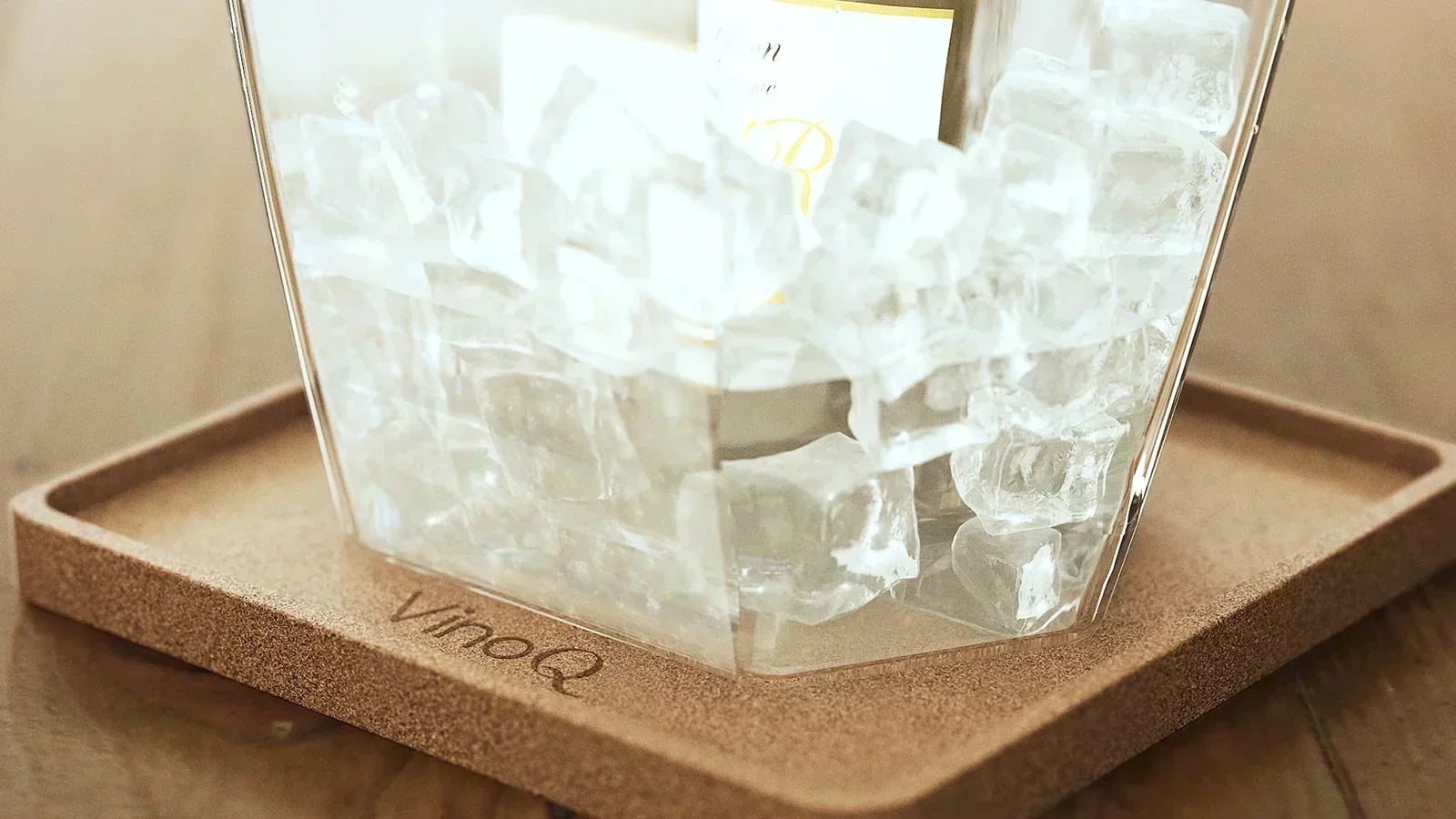
Getting a wine to its window is the easy part. As a rough guide, a bottle cools by around 1–2 °C every 10 minutes in the fridge, faster in an ice bucket, though the exact rate depends on the bottle and its starting temperature.
Tip: No thermometer needed. The "20/20" rule — take a white out about twenty minutes before serving, put a red in about twenty minutes before. Treat it as a rule of thumb, not a stopwatch. And in a hurry? An ice bath does it fastest: ice, water, and a good handful of salt will chill a warm bottle in about 15 minutes.
Holding that temperature is the harder part — and the part most people never think about. A bottle left standing on a warm table climbs back out of its window within minutes, and by the second glass you're drinking a noticeably different wine from the one you first poured. Reaching the right temperature is a moment. Keeping it there is the whole meal — which is exactly what a serving cooler is for.
Serving vs storage temperature
These are not the same number. Long-term storage aims for a steady ~12–14 °C — cool and, above all, constant, so a wine ages slowly and evenly. Serving temperature is style-specific, as in the chart above. A wine kept well still needs bringing to its serving window before it's poured: storage keeps a wine well, serving shows it well.
Tip: Store cool and steady (~12–14 °C); serve to the style. A well-kept bottle still needs bringing to its window before you pour.
The one variable worth controlling
Everything upstream of your glass — the site, the vintage, the cellaring — is already decided by the time you open the bottle. Temperature is the one variable left, and the only one you control. Getting it right, and keeping it there, is the difference between tasting an approximation of a wine and tasting the wine itself.
That's the step VinoQ is built to protect: the SoloVino and DuoVino bring a bottle to its proper temperature and hold it there, so what's in your glass stays true from the first pour to the last.
VinoQ. Taste it as it was meant to be.